| 27th October – 1st November 2008 |
By Diane Samuels Directed by Colin Edgerton |
Eva was 9 when her family put her on a train bound for England, just one of the tens of thousands on the ‘Kindertransport’. Now grown up, she has buried her German roots and the dark memories of that lonely journey until her daughter inadvertently discovers her past. This powerful drama, based on true-life events, opens our war-themed trilogy.
| Cast (in order of appearance) | Crew | |||
| Eva | Molly Hopkins | Set design | Graham House | |
| Helga | Lauren Milsom | Set Construction | Alan Croft & the | |
| Evelyn | Sarah Fordham | Chipstead Players | ||
| Faith | Katherine Sparshatt | Construction Crew | ||
| Lil | Anne Page | Stage Manager | Yasmine Leighton | |
| The Ratcatcher | Nick Foster | Lighting | Mike Dyson | |
| Sound | Jeff Stone | |||
| Furniture | Clare Sparshatt | |||
| Properties | Pauline Beckley & | |||
| Linda Hall | ||||
| Wardrobe | Margaret Ramsdale, | |||
| Anne Hopkins & | ||||
| Anna Sparshatt | ||||
| Production Manager | Jennifer Catley | |||
| Prompt | Rosalind Heath | |||




| Review: | By Jennifer Catley |
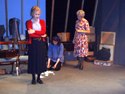
The cast all did well, with the help of antibiotics at times! Our 14-year-old Molly Hopkins does, however, deserve special mention. It was a huge part to learn, then there was the German, which she isn’t doing at school, plus all the action. Her grandfather thought she also ought to have learnt to play the harmonica – but Enough is Enough!
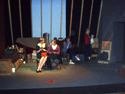
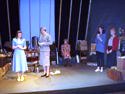
Graham House’s attic set was simple but effective and, together with the subdued lighting, created an atmospheric setting in which the action moved effortlessly from wartime Hamburg and London, to a modern suburban setting The entire theatre was searched for all the "stuff" in the attic, which just goes to show how things might come in useful one day – if you keep them long enough.
Lighting and sound were also a mammoth task in this production. The lighting alone had 62 computer cues, while the sound set the scene as the action moved from railway stations to ports and back again! Concentration was required all round.
This was a powerful and dramatic story in which the cast and crew were as emotionally involved as the audiences. The feedback from the latter is that the play entertained them while sending everyone away reflecting on the sad fate of the children of the "Kindertransport".
| Review: | By Derrick Graham of The Surrey Mirror |
The play at the Courtyard Theatre is the story of 9 year old Eva travelling from Hamburg to London, where she is taken in by Lil and brought up as her own daughter.
The problem for the audience was that the only setting was an attic room in Lil’s house, which had to also serve as Eva and her mother’s house in Germany. Then it became train carriages, stations and boats, and leaps in time from 1938, the 1940s and the present day, sometimes both going on at the same time on opposite sides of the stage.
Colin Edgerton, who directed the Chipstead Players, tried as far as possible to put in background sounds to indicate the location, and there were tiny clues such as Faith saying she would go for a "take-away", which indicated it was no longer 1938.
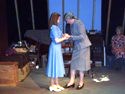
Molly Hopkins as Eva was brilliant, having to span an age range from 9 to 17 in the course of the play whilst being under 15 in real life. The emotional pressures of parting from her mother, which she believes will only temporary, and fear of the SS man on the train (a really horrible Nick Foster), joy on reaching Holland and the fear of the unknown when she reaches England, were all portrayed convincingly.
The excellent performance by Anne Page as Lil, who receives Eva into her London home, was marred by the difficulty of ageing her to the period she was playing. As a grey-haired lady in 1938 meeting Eva off the train, she looked exactly the same as the grandmother in the present day trying to make peace between her daughter Evelyn and grandaughter Faith. This was a problem in the writing, running different periods on the stage at the same time.
Lauren Milsom was Helga, Eva’s German mother, putting over well her distress in sending her daughter away, yet convincing her it was only for a month or two. She survives the death camps to die in America in 1989, yet appears in the attic, wonderfully aged, in the present time, to argue with her daughter, now played by Sarah Fordham. She is now Evelyn, bringing out well conflict with her own daughter Faith who has just discovered her family’s German/Jewish background.
Katherine Sparshatt (Faith), who was all set to move out to her own flat, put over well the emotions of leaving the nest and also the discovery that her family history was so vastly different from what she believed.
The attic was a very clever set, with a projected image of the Pied Piper, the Rat Catcher of Hamlin who led away the children.
| 11th – 13th September 2008 | Devised by the Junior Committee |
An Olde Tyme Music Hall by our multi-talented juniors from 6 – 14 was followed in this double-bill by a sneak preview showing of a 10-minute film made over one intensive weekend by the senior juniors, 11 – 16. It follows five determined youngsters as they concoct a scheme to rescue their community centre from imminent closure, with help – or hindrance! – from a few superheroes.
| Revue: The Good Olde Days |
Directed by Barbara Richardson & Lauren Milsom Musical Director: Jacqui Burke |
| Cast (in alphabetical order) | Crew | ||
| Alice Baty | Production Manager | Liz Bignell | |
| Daniel Baty | Stage Manager | Katherine Sparshatt | |
| Katie Bignell | Original Script Writing | Lauren Milsom | |
| Robert Bradshaw | Choreography | Alice Baty, | |
| Kelly Burke | Molly Hopkins, | ||
| Mary Burke | Amy Pinder-Hales, | ||
| Felicity Carr | Felicity Carr & | ||
| Jordan Crabtree | Mary Burke | ||
| Lewis Hayes | Costumes | Pat Andrews & | |
| Molly Hopkins | Roz Hayes | ||
| Rosie Jones | Programme | Edwina Marrow | |
| Lewis Khan | Sound | Gus van Manen, | |
| Frances Loosley | Jeff Stone & | ||
| Grace Mander | Harry van Manen | ||
| Ben Marrow | Lighting | Christina Lemon & | |
| Eloise Massimo | Graham House | ||
| Charlotte Morris | Spotlight | Ellie Jones | |
| Josh Morris | Set | Nick Gane & the | |
| Katie Milsom | Chipstead Players | ||
| Ellen Newman | Construction Crew | ||
| Georgia Pearson | Furniture & Props | Barnaby Pearson, | |
| Amy Pinder-Hales | Sullivan Pearson, | ||
| Katie Thompson | Kieran Cox | ||
| Piano | |||
| Alex Marrow, | |||
| Jacqui Burke | |||


| Film: Frame and Fortune |
Written by Katie & Lauren Milsom and Molly & Jo Hopkins from original ideas devised by the cast & crew Directed by Robert Bradshaw, Felicity Carr & Molly Hopkins |
| Cast (in order of appearance) | Crew | |||
| Delilah | Abigail Marrow | Producers | Jonathan Laverock, | |
| Emily | Katie Milsom | Graham House, | ||
| Harriet | Rosie Jones | Lauren Milsom & | ||
| Josh | Josh Morris | Jo Hopkins | ||
| Megan | Amy Pinder-Hales | Camera | Gus van Manen & | |
| Auctioneer | Graham House | Robert Bradshaw | ||
| Sound & Lighting | Jonathan Laverock & | |||
| Graham House | ||||
| Set Construction | Graham House, | |||
| Jo Hopkins & | ||||
| Jonathan Laverock | ||||
| AD/Continuity | Molly Hopkins, | |||
| Felicity Carr, | ||||
| Lauren Milsom & | ||||
| Lewis Hayes | ||||
| Props, Wardrobe & | Abigail Marrow, | |||
| Makeup | Felicity Carr, | |||
| Jo Hopkins, | ||||
| Katie Milsom & | ||||
| Amy Pinder-Hales | ||||
| Runners | Jo Hopkins & | |||
| Rosie Jones | ||||
| Editors | Lauren Milsom & | |||
| Jonathan Laverock | ||||
| Publicity | Josh Morris | |||
| Location Manager | Graham House | |||
| Review: | By Peter Steptoe of The Croydon Advertiser |


Their "Good Olde Days" Victorian potpourri replete with dictionary laden Chairman (Ben Marrow, aged 12) reflected the class distinction of the age. There were many good things from this cast of 23 that included six fellas. It had one ancient 15-year-old but many had only just reached double figures. Katie Bignell was only eight but gave us a sweetly sung "Wouldn’t It Be Loverly".
I liked the male rendition of "The Best Job in the World" (well, somebody has to do them) and the dancing of Felicity Carr (13) in "The Little Match Girl".
Comedians Robert Bradshaw (11) and Jordan Crabtree (11) gave us awful jokes of the "I say, I say" variety: "I come from Liverpool." "Which part?" "All of me."
The melodrama "The Cruel Landlord" was beautifully mimed, culminating in a duel in which the choice of weapons were pillows and the Landlord (Lewis Khan, 14) was only demolished by a frying pan-wielding heroine in Frances Loosley (11). A special mention here for the ladies who played the doors which opened and closed beautifully.
"Alice in Wonderland" by the girls gave us a fast moving display of costumes and characters, and "Doll on a Music Box" was brought to life by Molly Hopkins (14), Alice Baty (14) and Amy Pinder-Hales (13).
"Conversations in the Park" was in three parts, of which my favourite was the conversation between Florence Nightingale (Katie Milsom, 14) and Dr Jekyll and Mr Hyde, suavely and ferociously played by Josh Morris (12).
Katie Milsom also demonstrated "Busy Doing Nothing" in the item "A day in the life of a Victorian Lady", assisted by many menials.
Lauren Milsom and Barbara Richardson directed and I liked it a lot.
Critics should constructively criticise, and the piano playing was strident, interfering with audibility and the horses hooves were intrusive and somewhat monotonous.
The second half was an excellent short film made by the cast which satirised the meaningless daubs that position themselves as modern art.
| Review: | By Derrick Graham of The Surrey Mirror |
The little six-year-olds of two years ago who self-consciously watched the "big girls" (the 12 to 14-year-olds) to make sure they got it right, now have stage presence and confidence.
Their latest production, "The Good Old Days", had sufficient variety to enable many of the children to show off their skills, with Ben Marrow, aged 12, as the chairman of this music hall having all the confidence of an established performer.
Josh Morris, at a similar age, is now an old hand at the sort of noisy comedy he does so well, seen in a double act with Robert Bradshaw trying their hands at stand up comedy.
The first night is always exciting, with everybody wound up and ready to go, and the auditorium full of parents friends and grandparents.
The first four items were from musicals – and were excellent, especially Katie Bignell (8) as Eliza Doolittle singing "Wouldn’t it be loverly" from "My Fair Lady". Although all the principals had radio mikes, these were not obvious and at row C it was evident that their voices were being well projected even so.
There were no distinctive boy and girl choruses – everyone was in everything interspersed with good solo items. Where a backdrop was needed these were projected and the screen was also used for silent movie titles with the actors playing out "The Cruel Landlord" in front, to piano accompaniment. Frances Loosley, Daniel Baty and Lewis Khan were the principals in this.
After a variety of good entertainment there followed a film written by four of the members from ideas put forward by the cast and crew. "Frame and Fortune" told of the efforts of a group to save their youth club from closure by auctioning a picture they had painted. Much splashing of paint on the floorcloth produced a surrealistic masterpiece which was sold for a vast sum and saved the clubhouse.
It was well acted and edited by 12-plus members of the Junior Players.
| 14th – 19th July 2008 |
By Charlotte Jones Directed by Jeff Stone |
A comedy about broken vows, failed hopes and the joys of bee-keeping. Felix Humble is a Cambridge astro-physicist in search of a unified field theory. Following the sudden death of his father, he returns home to his difficult and demanding mother, where he realises that his search for unity must also include his own chaotic home life. "A play about life and death, love and lust, guilt and hope and dreams and the whole damn thing. It has some of the best writing I’ve come across recently" – Sunday Times.
| Cast | Crew | |||
| Jim | Mike Park | Set design | Jennifer Catley | |
| Flora | Val Young | Stage Manager | Nick Gane | |
| Felix | Mike Strong | Production Secretary | Mary Morgan | |
| Mercy | Anne-Marie Carlile | Set Construction | Chris Catley & the | |
| George | Mel Morgan | Chipstead Players | ||
| Rosie | Kirsty Cunningham | Construction Crew | ||
| Lighting | Graham House | |||
| Sound | Don Hindle | |||
| Properties & | Jo Hopkins & | |||
| Furniture | Clare Sparshatt | |||
| Wardrobe | Audrey Simpson, | |||
| Liz Lockhart-Mure | ||||
| Continuity | Isabel Francis | |||


| Review: | By Derrick Graham of The Surrey Mirror |
His father, James, spent a lifetime studying bees and created a superb terraced garden surmounted with a large beehive. This set was fantastic, mostly real flowers, or artificial ones correct to fit the storyline. An apple tree overhung one side of the stage, with a ripe apple dropping on cue to be eaten. The garden is tended by Jim (Mike Park), watering the plants when the audience enters and at various times during the play and during the interval. His only dialogue is with Felix and he is ignored by the rest of the cast.
James has just died and at the family gathering were his widow, Flora, a brilliant, strong no-nonsense characterisation by Val Young, Mercy, a neighbour, George, with whom Flora has been having an affair for the past seven years, and Felix.
Mel Morgan as George made a most convincing drunk, singing, jiving and bursting with party spirit, and generally getting more obnoxious until, in the end, Flora finishes with him.
His daughter Rosie is the one with the seven year old child, a very sensitive performance by Kristy Cunnington, still slightly in love with Felix, but realising it would be a hopeless union.
The character of Mercy is a difficult one as she is the friend who Flora doesn’t really want, always coming round to help, and combating a lonely spinsterhood by attaching herself to the Humble family. A very moving performance by Anne-Marie Carlile in a role which won the actress in the first production at the National Theatre in 2001 an award for best supporting actress.
Whilst alone with Felix in the garden, Vera hears him talking to the gardener and turns to see that Jim is her beloved James, who in spirit has been tending the flowers he so loved. A superb performance as he describes the plants by their Latin names, and how the bees he loved kept propagating them.
Timing and stage movements were critical to "Humble Boy", especially where one of the characters is invisible except to Felix. Direction was brilliant, a great tribute to Jeff Stone.
| 26th – 31st May 2008 |
By Alan Bennett Directed by Warwick Beazley |
Max Brod and Franz Kafka somehow turn up at the Leeds, UK home of Sydney, an insurance agent and Kafka scholar, and his wife Linda. Brod and Sydney try to hide the fact that Kafka is now world famous and not reduced to ashes as he wished by hiding his books. When they leave the room for a moment, Kafka finds out the truth.
| Cast | Crew | |||
| Kafka | Philip Laughton | Set design | Linda Hornzee-Jones | |
| Brod | Rick Thompsett | Stage Manager | Yasmine Leighton | |
| Linda | Kate Perry | Set Construction | Alan Croft & the | |
| Father | Don Hindle | Chipstead Players | ||
| Sydney | Brian Aris | Construction Crew | ||
| Hermann K | Colin Edgerton | Lighting & Sound | Graham House, | |
| John Gallagher & | ||||
| Mike Dyson | ||||
| Wardrobe | Margaret Palmer, | |||
| Rosie Bennett & | ||||
| Anne Hopkins | ||||
| Properties | Louise Delaney | |||
| Furniture & Set Dressing | Clare Sparshatt | |||
| Hair & Make-up | Fay Whitmore | |||
| Prompt | Rosalind Heath | |||
| Production Secretary | Linda Hall | |||
| Programme cover design | Andrew Frith | |||


| Review: | By Derrick Graham of The Surrey Mirror |
The Prague writer Kafka (1883-1924) had only had one book published and in Bennett’s play, set in 1920, when dying of a tumour, he asked his friend Max Brood, to burn all his papers, after he dies. Max – a brilliant performance by Rick Thompsett, tries to get Kafka to change his mind, but he passes convinced his friend will obey his dying wish.
Forward to the 1980s and insurance salesman Sydney is writing an article on Kafka for his company’s magazine. Due to Max publishing, not destroying, his works, Kafka is a world famous author (that part is true) and Sydney has all his books. Brian Aris put over perfectly this uninteresting man, obsessed with Kafka and ignoring his gorgeous wife Linda, who has much more exciting ideas for using the sofa than sitting on it to read. Kate Perry made a wonderful foil against the very short Kafka (whose physical shortness elsewhere meant most of his romances were short lived) also towering above the equally short Max.
Bennett indulges in a bit of fantasy and imagines what would be the result if these two had been re-incarnated. Kafka is now Linda’s pet tortoise, an all moving realistic prop and Max (whose reincarnation is not explained), whilst seeking a toilet, uses the garden instead, just where the tortoise is resting. This causes Kafka to reincarnate (fully dressed) and they both go back into the house, where Kafka soon realises from the contents of Sydney’s bookcase that Max has not carried out his dying wish. Matters are further complicated by a visit from the re-incarnated Kafka Senior, as a policeman played by Colin Edgerton.
A good cameo role for Don Hindle as Sydney’s father, desperately trying to show his memory is still sharp enough to avoid being put into Care, but getting even more confused by all these strange visitors.
They finally all end up in God’s sitting room where Kafka’s father is now God, Max is the Archangel Gabriel and Linda a sort of Carmen Miranda.
Weird, but brilliantly played, and directed by Warwick Beazley.
| 7th – 12th April 2008 |
Written & Directed by Yasmine Leighton & Jeremy Nicholls Choreography by Barbara Richardson |

It’s been 10 years since "Bully for You" was first written & peformed here at Chipstead, but the ideas that first prompted this musical play have not gone away. Some new material has been written by Yaz and Jeremy to enhance the story line for 2008; "Bully for You Too" is the result.
It tells the story of Alex, a young boy in his first year at St. Inglenook’s secondary school. Being a new boy, he is easily picked on, and Bates the bully and his mates are on hand to make sure they get their fair share of the easy pickings. Packed with amazing characters, fantastic dances and the most wonderfully catchy tunes, "Bully for You Too" will have you singing your heart out at the finale.
| The Cast | |||||
| Main characters | |||||
| Alex Jones | Ben Marrow | ||||
| Benita | Benita Murphy | ||||
| Bates | Lewis Khan | ||||
| Andrew | Lewis Hayes | ||||
| Mr. Johnson | Alex Clark | ||||
| Rigsy | Josh Morris | ||||
| Smithy | Gus van Manen | ||||
| Mrs. Brown | Kerry-Ann Radburn | ||||
| Alex’s Mum | Katherine Sparshatt | ||||
| Alex’s Dad | Alex Clark | ||||
| The Headmaster | Alex Marrow | ||||
| Mrs. Bates | Annie Searle | ||||
| Head Cleaner | Amy Pinder-Hales | ||||
| School Children | Katie Bignell, Phoebe Carney, Tom Carney, Ben Gilbert, | ||||
| Emily Headcock, Katie Headcock, Henry Hinder, | |||||
| Frances Loosley, Charlie Mabbutt, Georgia Pearson, | |||||
| Eleanor Percival, Joe Percival, Megan Ridge | |||||
| Teachers/Parents | Felicity Carr, Molly Hopkins, Grace Mander, Abigail Marrow, | ||||
| Charlotte Morris, Amy Pinder-Hales, Annie Searle, | |||||
| Josie Searle | |||||
| Gang Members | Tom Carney, Ben Gilbert, Lewis Hayes, Henry Hinder, | ||||
| Joe Percival | |||||
| Mrs. Bates’ Children | Katie Bignell, Phoebe Carney, Frances Loosley | ||||
| Charlie Mabbutt, Eleanor Percival, Megan Ridge | |||||
| School Cleaners | Felicity Carr, Grace Mander, Abigail Marrow | ||||
| Charlotte Morris, Josie Searle | |||||
| The Band | |||||
| Piano | Jeremy Nicholls | ||||
| Keyboard 1 | Anthony Strong | ||||
| Keyboard 2 | Christopher Kenyon | ||||
| Guitar | Dan Howard | ||||
| Drums | Tom Milsom | ||||
| The Production Crew | |||||
| Production Managers | Suzanne Searle & Edwina Marrow | ||||
| Costumes | Pat Andrews, Vicky van Manen & Anna Sparshatt | ||||
| Properties | Louise Canfield & Rosie Jones | ||||
| Stage Manager | Edwina Marrow | ||||
| Set construction | Nick Gane and The Chipstead Players Construction Crew | ||||
| Lighting | Kit Wisdom | ||||
| Sound | Harry van Manen | ||||
| Furniture | Clare Sparshatt | ||||
| Backstage and Spotlights | James Mabbutt, Hannah Mabbutt, Genevieve Coombe, | ||||
| Dominic Binefa, Beth Nixon, Barnaby Pearson, | |||||
| Sullivan Pearson, Jonathan Land | |||||
| The Directors would also like to thank: | |||||
|
|||||
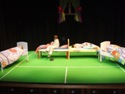
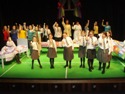
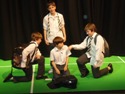

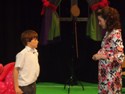




| Review: | By Derrick Graham of The Surrey Mirror |
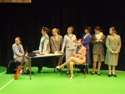
The 32 children in "Bully for You" were amazingly talented and Yasmine Leighton, the director, said they had been a joy to work with.
The youngest was Katie Bignell, who at eight had all the confidence of an experieinced performer, while the eldest, Kerry-Ann Radburn, 17, played Mrs. Brown, the terrifying maths teacher.
At St. Inglenook’s School there is a sudden influx of new pupils due to their previous school having burnt down. Mr. Bravo, the headmaster, is definitely "cool" according to his team of lady teachers, who swoon over their leather-clad, motorcycle riding, young chief, with a phoney American accent.
The brash performance is just that – he keeps a stuffed animal in his desk to cuddle after a tough interview. Great characterisation by Alex Marrow.
The school bully is Bates, well-played by Lewis Khan. It must be difficult to be really nasty all the time when you’re really quite happy.
As the story unfolds it becomes clear why he wants to bully younger childen: he is one of a family of seven, with no father and a mother (Annie Searle) who is struggling to cope.
His victim is Alex Jones, who comes from a good home with a supportive mother and father. Katherine Sparshatt came over well as the sympathetic mother. Mr. Jones, played by Alex Clark, was more of a problem. With his distinctive pony tail,more thought should have been given to his double role as Mr. Johnson, a member of the school staff. Playing two roles is fine as long as the characters look different.
Ben Marrow as Alex was excellent, looking thoroughly miserable after being bullied and brightening up as he learns how to resist and become a happy boy as he makes friends with Bates, who realises the error of his ways.
There were plenty of good songs, which were well sung and clearly heard thanks to radio mics and excellent backing by musical director Jeremy Nicholls. There was also a fine dance sequence of school cleaners with choreography by Barbara Richardson.
| Review: | By Theo Spring of The Croydon Advertiser |
The butt of the gang is Alex Jones (Ben Marrow), whose clear diction and tuneful voice made sure all his words were clearly heard. Equally good on these deliveries was Lewis Khan as Bates, the leader of the gang who eventually sees the error of his ways. Smith (Gus van Manen) and Rigsy (Josh Morris) are Bates’s main henchmen, carrying out the bullying orders so that Bates himself never does any of the actual dirty work. This pair brought comedy to their rôles and lightness to the plot.
The leading members of staff were the idiosyncratic Mrs. Brown, with Kerry-Ann Radburn alternating between her strict and flirty side, and Mr. Bravo, Headmaster, played by Alex Marrow in the rock star mould and favouring an Elvis delivery. Although all his staff swoon at the mention of his name, he is still big on fair treatment and won’t tolerate bullying in his school.
Alex’s Mum and Dad help out with sensible advice. Alex Clark as Dad expressed his thought in song, doing particularly well when imitating Grandad complete with wonky knees. Katherine Sparshatt as Mum gave cuddles, comfort and more good advice, also charmingly, in song.
A strong chorus provided schoolkids of all ages, more teaching staff and the wonderful cleaners, led by Amy Pinder-Hales, who believe cleaning the school to be an art and who can turn their hand to Morris Dancing at tyhe flick of the right duster – a comic highlight – alongside the woes of a large family, expressed by Annie Searle as Mrs. Bates.
Sete were straightforward with the school playground having an excellent backdrop, and movement, under the guidance of Barbara Richardson’s choreography, was effective.
The programme included some bullying facts and how to beat it. The script is available for school productions via the website, allowing more children to absorb this powerful message dressed up in such a palatable form.
| 25th February – 1st March 2008 |
By Frederick Knott Directed by Sharon Radburn |
Three crooks, desperate to find a drug-filled doll, plot to compel the owner to give away its whereabouts. They tell the owner’s blind wife a frightening story about her husband’s supposed infidelity, but she becomes suspicious and in a terrifying climax makes use of the advantage that the blind have over the sighted in the dark.
| Cast | Crew | |||
| Mike | Jerry Phillips | Set design | Miles Ruffy | |
| Croker | Mike Stroud | Stage Manager | Mel Morgan | |
| Roat | Jeremy Taylor | Set Construction | Chipstead Players | |
| Suzy Henderson | Katie Phillips | Construction Crew | ||
| Sam Henderson | Neil Hobbs | Lighting | John Gallagher | |
| Gloria | Grace Mander | Sound | Jeff Stone | |
| 1st Policeman | Don Hindle | Properties | Delia Lord & | |
| 2nd Policeman | Charlie Crowther- | Mary Morgan | ||
| Smith | Costumes | Margaret Ramsdale & | ||
| Christine Earp | ||||
| Prompt | Pam Jarrard | |||
| Production Assistant | Jon Laws | |||




| Review: | By Peter Steptoe of The Croydon Advertiser |
Great credit goes to director Sharon Radburn, who racked up the suspense until the sound of our jangled nerves was almost audible. A silent audience in this case was because fingernails were almost down to the first knuckle.
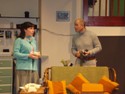
Susy Henderson was blind and, played by Katie Phillips, she appeared to be; always bumping into misplaced furniture must have left her black and blue by the end of the run.
Blind people can see audibly, so to speak, and when husband Sam (Neil Hobbs) brings home a doll containing drugs/diamonds, the appearance of three con men entering the basement flat in search of the toy sets our pulses racing as she begins the fight back.
Mike (Jerry Phillips) poses as her husband’s former army friend, Mike Stroud says he is Detective Sergeant Croker, and, last but not least, Harry Roat (Jeremy Taylor), the personification of evil, manages to play both father and son in a conman’s concoction that leaves us in wonderment at its ingenuity.
Then there was Gloria (Grace Mander), a child who was so horrible to the blind girl that I had to stop myself from verbal abuse. She reformed, but I never quite trusted her.
The set as a semi basement was excellent, with the staircase to the front door having a solidity that looked permanent, and John Gallagher on lighting, with Jeff Stone for sound, never missed a trick.
The final scene of the power of darkness contest between Roat and blind Susy was beautifully choreographed, and the refrigerator when opened that turned the darkness into light was a tour de force.
Some years ago I saw a professional touring company perform this play with a cast that contained two TV stars. I can truthfully say that Chipstead were the better players.
| Review: | By Tony Flook of The Surrey Mirror |
In the end, it’s Susy against Roat, the criminal puppet-master who will stop at nothing to get his hands on the drugs, until darkness gives her the edge.
Frederick Knott’s 1966 play may seem a little dated now, but Chipstead Players’ strong production, directed by Sharon Radburn, brought it vividly to life, proving just how tightly good live theatre can hold its audience.
The first thing to catch attention was Myles Ruffy’s stage design, enhanced by properties sourced by Delia Lord and Mary Morgan.
The two-level set, with sturdy, realistically dark-painted stairs leading down from the front door to the basement flat, played a crucial part in the plot.
The kitchen equiment – from fridge and gas cooker, through plastic-covered stools to utensils, all seemed right for the period. Only the doll itself looked too flimsy to be carrying two pounds of heroin.
Jerry Phillips, Mike, the first villain on stage, dropped his London accent for middle-class tones as he convinced Susy that he was a friend of Sam. He was, perhaps, the most insidious of the trio, winning her trust while setting her up for his partners. Mike Stroud, as Croker, who appeared in various guises in this cat-end-mouse game, was the first to perish at the hands of ice-cold Roat, portayed with eerie menace by Jeremy Taylor.
Their prey, Susy, played by Katie Phillips, convinced the audience of her blindness from her first entrance. She kept in character throughout as she walked around the flat, occasionally (and, no doubt, painfully) stumbling into furniture.
Initially trusting Mike and the other dubious visitors to the flat, she gardually became suspicious, then terrified as Roat made his final attempt to get the doll and its contents. It was a meticulously built interpretation.
Chipstead Players– policy of developing young talent proved its value as 13-year-old Grace Mander stepped into her first rôle in an adult play as Gloria, Susy’s stroppy helper who came, heroically, to the rescue when the chips were down.
|
2nd – 6th January 2008 9th – 12th January 2008 |
By Anthony Drewe & George Stiles Directed by Chris & Emily Evans |
Based on "The Ugly Duckling" and set in a farmyard, this charming musical is written as an ensemble piece requiring the actors to play 30 animal and human characters.
| Cast | Crew | |||
| Drake | James Mabbutt | Production Assistant | Nicky Evans | |
| Turkey | Peter van Manen | assisted by | Edwina Marrow | |
| Henrietta | Katherine Sparshatt | Dian Mabbutt | ||
| Maureen | Lauren Milsom | Wardrobe & Costumes | Pat Andrews & | |
| Ida | Jacqui Burke | Ros Hayes | ||
| Cat | Lewis Wilmott | assisted by | Anna Sparshatt, | |
| The Ducklings | Anne Franks & | |||
| Beaky | Joanna Hollington | Liz Lockhart-Mure | ||
| Fluff | Katie Bignell | Properties | Clare Sparshatt, | |
| Billy | Josh Morris | Rosie Bennett & | ||
| Downy | Charlie Mabbutt | Julia Mander | ||
| Ugly | Ian Radburn | assisted by | Ruth Bury, | |
| Maggie Pie | Rachel Reeve | Rebcca Hart & | ||
| Floor Manager | Lewis Khan | Abigail Mander | ||
| Wild Goose Squad | Stage Manager | Colin Edgerton | ||
| Greylag | Steven Jacobs | assisted by | Nick Gane | |
| Dot | Elayne Teague | Stage Crew | Alan Croft, | |
| Barnacles | Gus van Manen | Mel Morgan & | ||
| Pinkfoot | Rosie Jones | Paul le Fevre | ||
| Snowy | Suzie Fitzwater | Set Construction | Chipstead Players | |
| Lowbutt | Barbara Richardson | Construction Crew | ||
| Queenie | Beverly Clark | Set Design | Estelle Forsberg | |
| Penny | Alex Richardson | Lighting | Graham House | |
| Mother Swan | Elspeth Marrow | Sound | Mike Dyson | |
| Bullfrog | Harry van Manen | Hair & Makeup | Isla Perry | |
| Bewick | Grace Mander | Prompt | Laureen Henderson | |
| Father Swan | Alex Clark | |||
| Chorus | Lucy Bennett, | HONK! Band | ||
| Kelly Burke, | Piano 1 | John Collis | ||
| Mary Burke, | Piano 2 | Chris Evans | ||
| Lewis Hayes, | Clarinet & Alto Sax | Alex Marrow | ||
| Jonathon Land, | Percussion | Darrell Williams | ||
| Katie Milsom & | Bass | Matt Palmer | ||
| Eleanor Percival | ||||


| Review: | By Derrick Graham of The Surrey Mirror |
It’s an excellent show for a company of mixed ages, and Chipstead Players utilised the skills of their Juniors and many adults to make this a spectacular production.
The direction was by Emily Evans, with father Chris as Musical Director, with choreography by Helen Parker.
No masks or animal/bird costumes were used, but ordinary clothes that in a way suggested the character. Thus the Tom Cat (Lewis Wilmot) was in a dark suit with very broad stripes, and cat Queenie (Beverly Clark) in a sleek black dress with a jazzy white pattern.
The setting was a duckyard with the vertical supports of a barn (impressive large posts), on the roof of which were the orchestra. At the rear was a large nest containing 4 small eggs and one very large one.
Sitting on the nest was Ida, the mother duck, a fine performance by Jacqui Burke, whose mate, Drake (James Mabbutt) declines to take his share of the hatching. Four of the eggs hatch and out come small children in white overalls and yellow wellington boots, who are welcomed by their mother and her friend Maureen (Lauren Milsom).
The ducklings, Joanna Hollington, Josh Morris and Charlie Mabbutt were all excellent, but Katie Bignell, a tiny 8 year old, stole the show with a fabulous performance. Finally the big egg hatched to disclose Ian Radburn, a far from Junior Player, dressed as a schoolboy. Not surprisingly, the ducks all called him Ugly, especially when he finds he can’t quack, only honk.
The cat sees him as a tasty meal and invites him to dinner, where he starts to prepare Duck a l’Orange, but, after a lot of fun throwing oranges about, he escapes and goes into the marshes and gets lost.
It’s now late summer and the wild geese are getting into formation ready to fly away. Led by Commander Greylag (Steven Jacobs) and his wife Dot (Elayne Teague) in RAF uniforms, they delay their departure to search for Ugly’s mother. A burst of gunfire and a shower of feathers indicates that "the people" have brought the mission to an end.
Ugly later meets up with a young swan, Penny (Alex Richardson) who realises he is going to be a handsome cygnet after his moult and, when she flies back in the Spring, decides to leave her family and pair with him on the lake.
The show was packed with some excellent songs, a superb chorus of Ducklings, Geese and Frogs, with many imaginative dances. One special mention must go to Harry Van Manen as the Bullfrog. A wonderful leaping performance, brilliant costume and an outstanding characterisation.